
Your Approval Process Is Not a Control
NetSuite approvals often confirm that someone reviewed a transaction, not that the assumptions behind it were valid.
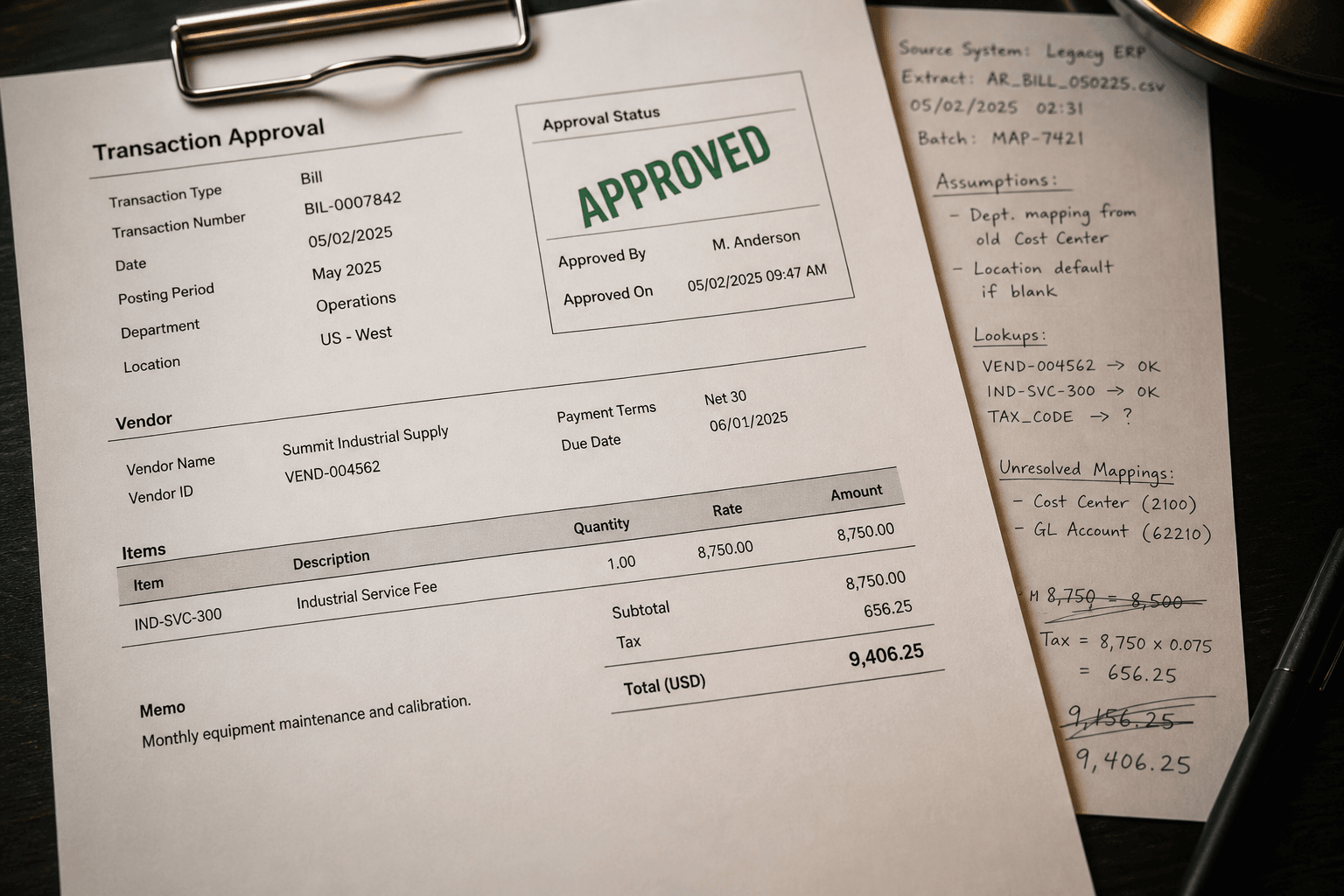
Your Approval Process Is Not a Control
An approval means someone clicked a button.
It does not mean the record is right.
In NetSuite, that difference matters.
The Approval Is Usually Too Late
Most approval workflows sit near the end of a process.
A sales order gets entered.
A vendor bill gets keyed.
An expense report gets submitted.
A journal entry gets routed.
By the time the approver sees the transaction, most of the important decisions have already happened.
The customer was selected. The item was chosen. The price was sourced. The department was assigned. The subsidiary was inferred. The tax code was set. The exchange rate was accepted. The integration mapped fields into place.
The approval step sees the result.
It often does not see the assumptions.
That is where the control gap lives.
Approvers Review What NetSuite Shows Them
Approvers are usually reviewing a screen.
They see the transaction header, line items, totals, memos, maybe attachments, maybe a custom approval tab.
That view can be useful.
It is also incomplete.
A transaction can look reasonable while still being wrong.
The price can match the line but come from the wrong price level.
The customer can be valid but tied to stale payment terms.
The department can be populated but chosen by habit instead of policy.
The vendor bill can tie to a purchase order while still carrying the wrong amortization schedule.
The approval screen gives the appearance of inspection.
But unless the workflow exposes the upstream conditions that matter, the approver is mostly reviewing a polished version of the problem.
Bad Data Often Looks Normal
This is why approval processes become rubber stamps.
Not because people are careless.
Because the record looks ordinary.
Bad data in NetSuite rarely announces itself. It hides inside valid fields.
A classification is present.
A vendor is active.
An item has an expense account.
A customer has terms.
A script populated the field.
A middleware process sent the payload.
From NetSuite's perspective, the record can be complete enough to save, route, approve, bill, fulfill, post, and report.
That does not mean it is correct.
I have seen invoices approved with wrong revenue treatment because the item setup was wrong.
I have seen purchase orders approved with the wrong department because a copied transaction carried forward old context.
I have seen vendor bills approved because the total looked fine, while the line-level coding was quietly polluting reporting.
Nobody caught it at approval because the approval process was never designed to catch it.
It was designed to collect permission.
That is not the same thing.
Workflow Is Not Governance
NetSuite workflows are useful.
They can route records, enforce state transitions, capture approvals, send notifications, and prevent certain actions.
But workflow is not governance by itself.
A workflow answers a narrow question:
"Who needs to approve this record before it moves forward?"
Governance asks different questions:
- What data must be valid before this record exists?
- Which assumptions should be enforced by script, workflow, or configuration?
- What should be impossible for users to select?
- Which exceptions need a separate path?
- What should be logged for audit instead of hidden in a memo?
Those are harder questions.
They require understanding the process before the transaction reaches the approver.
That is why approval workflows are often overtrusted. They are visible. They are easy to point at. They create an audit trail.
But an audit trail of bad decisions is still an audit trail of bad decisions.
The Real Control Lives Upstream
Strong approval processes start before approval.
They start with field sourcing, role design, mandatory data, saved search alerts, SuiteScript validation, integration rules, item setup, customer terms, vendor controls, and exception handling.
If the wrong department should never be used on a transaction type, do not depend on an approver noticing it.
Restrict it.
If certain items require project coding, do not hope someone checks the line.
Validate it.
If an integration defaults missing values to a generic fallback, approval should not hide that gap.
Surface it before the record routes.
Approvals are better when they review exceptions, not routine data hygiene.
The more basic validation you push onto approvers, the less effective the approval process becomes.
People get used to clicking through.
They learn which records usually pass.
They start trusting the system to have done the checking.
That is exactly when bad data gets through.
Make the Risk Visible
If approval is going to matter, the approver needs context.
Not more fields.
Context.
A good approval screen should show why the record routed.
It should show whether pricing was overridden.
It should show whether the record came from an integration, a copy, or manual entry.
That is enough to change the review.
The approver should not have to reconstruct the entire business process from a transaction form.
That is a common failure pattern in NetSuite environments: the system technically contains the information, but the approval experience does not surface it.
So the approver clicks approve. And downstream, someone eventually finds the problem the workflow was never configured to catch.
Approval Is the Last Gate
Approvals work best as a final judgment point.
They should confirm that a transaction is reasonable after the system has already enforced the obvious rules.
They should not be the first meaningful control in the process.
When approval becomes the first real check, every upstream weakness gets pushed onto a person staring at a record under time pressure.
That does not scale.
It also creates a strange kind of blame.
The approver "approved" the record, so the assumption is that they accepted the risk.
But did the system actually surface the risk? Did anything prevent invalid choices before submission?
If the answer is no, the approval was mostly ceremonial.
Bottom Line
An approval process is visible.
It creates an audit trail.
It feels like a control.
That does not make it one.
If the approver only sees the transaction, they are reviewing the output of the process, not the quality of the process.
Real control happens where bad assumptions enter the system.
By the time someone clicks approve, the record may already be wrong.
Dealing with this in your own NetSuite account?
We fix exactly these problems in production. Run a free read-only health scan, or talk to a senior NetSuite consultant who has seen it before.

Written by Mike Pagani, founder of Adaptive Solutions Group — a NetSuite consultancy based in Pittsburgh, PA. Mike has been building SuiteScript automations, integrations, and NetSuite rescue projects since 2013.