
Choosing the Right NetSuite Consulting Partner: What Actually Matters in Production
How to evaluate a NetSuite consulting company or consultant based on production-first architecture across scripting and integrations—before late-stage UAT reveals changes that are too large to fix safely.
Choosing the Right NetSuite Consulting Partner: What Actually Matters in Production
Introduction
Selecting a NetSuite consulting company should be straightforward.
Review credentials.
Meet the potential fit.
Discuss the project with them.
Compare rates and benefits.
Pick the best fit.
But in real production environments, success—or failure—rarely depends on certifications or slide decks.
It depends on something far less visible:
Whether the consultant understands how NetSuite and its integrations behave under real-world load, data volume, and operational pressure.
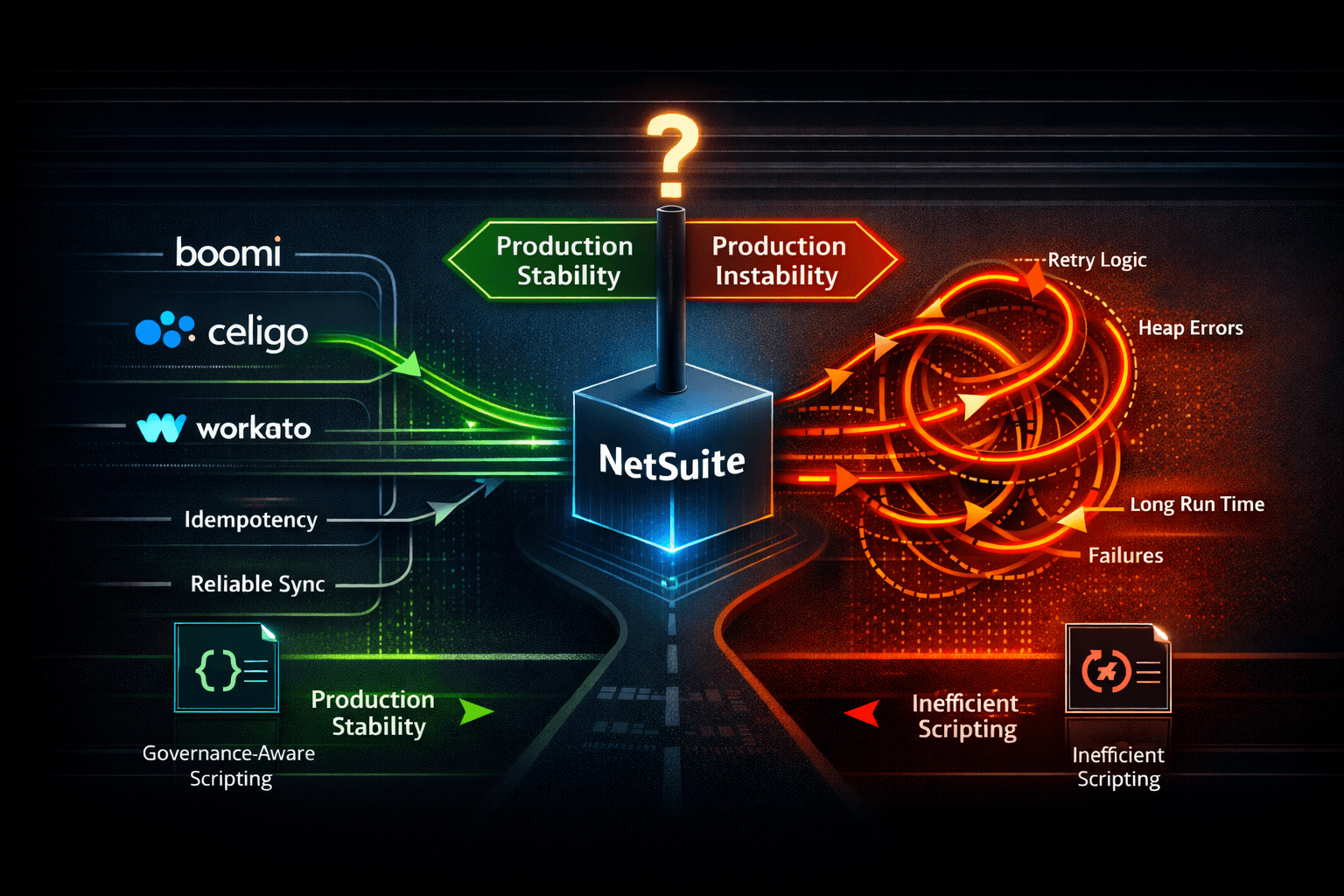
And this is especially true for integration platforms like Boomi, Celigo, and Workato—where problems often stay hidden until production scale exposes them.
After more than a decade inside live NetSuite ecosystems, one pattern shows up repeatedly:
The biggest client pain usually originates from a consulting decision that seemed valid across architecture, build, and testing, but failed to account for real production behavior.
UAT can uncover these flaws, but by then the remediation often requires structural changes that are impractical to introduce so late in the lifecycle.
This post explains how to evaluate a NetSuite consulting partner based on what actually matters once the system is live.
1. Production Experience vs. Demo Experience
Many consultants can:
- Configure records
- Build saved searches
- Write SuiteScript that works in sandbox
- Deliver clean demos
- Stand up an integration flow that processes a few records successfully
Far fewer can design solutions that survive:
- 10× transaction growth
- Concurrent integrations firing simultaneously
- API rate limits and throttling
- Governance exhaustion under load
- Real user behavior—not scripted QA paths
This gap is even more dangerous in Boomi, Celigo, and Workato, where:
- Small design flaws scale into data duplication or loss
- Retry logic creates infinite loops
- Partial failures silently corrupt financial or operational data
Ask directly:
- What failed in your last production go-live?
- How did you detect it before the client did?
- How did you fix it without downtime or data damage?
Real production experience always includes war stories—because real systems are messy.
2. Governance Matters—But Integration Architecture Matters More
SuiteScript governance is a hard technical limit that must shape design decisions.
Strong consultants will:
- Prefer Map/Reduce over long-running User Events
- Minimize record loads and searches
- Design retry-safe processing
- Measure usage units before go-live
But here's the deeper reality:
Bad integrations can take down more than NetSuite—they can destabilize the entire operational ecosystem.
Poorly designed Boomi, Celigo, or Workato flows can:
- Flood NetSuite with unnecessary requests
- Lock records through concurrency collisions
- Reprocess the same transaction multiple times
- Create silent financial inconsistencies
If governance is ignored, scripts fail.
If integration architecture is ignored, entire businesses feel it.
3. Happy-Path Integrations vs. Production-Safe Integrations
Most integrations succeed during:
- Initial build
- Controlled QA
- Demo scenarios
They fail when reality appears:
- External APIs slow down
- Message queues back up
- Duplicate events arrive
- One step succeeds and the next fails
- Large historical replays hit production
A production-ready consulting partner designs for:
- Idempotency (safe reprocessing)
- Retry queues with visibility
- Rate limiting and back-pressure
- Clear error surfacing for business users
- Data reconciliation between systems
If the strategy is:
"We'll log the error and check later,"
that's not production architecture.
That's delayed failure.
4. Real Production Failure: When Integration Design Becomes the Constraint
In a recent engagement, two consultants were working in parallel on separate integration flows within the same NetSuite ecosystem.
The flows that were carefully architected for scale, memory usage, and retry behavior have continued running in production without incident.
The other set of flows—built without the same production considerations—eventually required emergency intervention.
By the time issues surfaced, it was too late for a clean redesign, and the business needed stability more than perfection.
The symptoms were severe but familiar:
- Middleware scripts encountering heap space exhaustion
- Executions running for extreme durations—including one that reached the 24-hour platform termination limit
- Cascading retries, slow processing, and operational errors across dependent processes
None of these failures were caused by unusual edge cases.
They were the predictable result of architecture decisions that did not account for production behavior—memory constraints, data volume, and long-running execution patterns.
And importantly:
These issues were technically avoidable through either selecting the right implementation approach early or redesigning the flow before go-live.
But real businesses don't operate in perfect conditions.
Budgets, timelines, and competing priorities often mean organizations must stabilize what exists rather than rebuild what's broken.
So instead of a clean architectural correction, teams are left managing:
- Performance degradation
- Intermittent failures
- Operational workarounds
- And the growing cost of technical debt
Until eventually, the only viable path forward is to rip off the band-aid and redesign the system properly.
5. Communication Style Predicts Technical Outcomes
Technical skill is essential.
But communication determines whether a project succeeds without chaos.
Strong consultants:
- Translate technical risk into business impact
- Raise concerns before go-live
- Provide clear tradeoffs, not vague options
- Document decisions for future maintainability
- Think in years of stability, not weeks of delivery
Weak engagements often sound like:
- "That's just how NetSuite works."
- "Boomi sometimes does that."
- "We can fix it after launch."
In ERP and integration systems, surprises are expensive.
Clarity is mandatory.
6. Red Flags Clients Commonly Miss
Watch for these early indicators:
Speed prioritized over stability
Fast builds that ignore scale usually create slow operational disasters.
No failure-scenario design
Production systems will fail. Mature architects plan for that.
Integration treated as plumbing
Boomi, Celigo, and Workato are not just connectors—they are core system architecture.
Heavy customization without restraint
Not every issue needs SuiteScript.
Not every workflow belongs in middleware.
Balance matters.
No ownership beyond go-live
If the system only works while the consultant is present, it isn't finished.
7. What a Strong NetSuite & Integration Partner Looks Like
The best consulting relationships consistently demonstrate:
- Production-first thinking
- Governance-aware SuiteScript design
- Resilient Boomi/Celigo/Workato architecture
- Clear, direct, proactive communication
- Long-term maintainability over short-term speed
Most importantly:
They build systems that still work years after go-live—not just on demo day.
Final Thought
Choosing a NetSuite consulting partner isn't really about:
- Certifications
- Hourly rates
- Polished demos
It's about trusting someone with the operational backbone of your business—
including the integrations that move your data, revenue, and reporting.
And in NetSuite ecosystems:
Stability is never accidental.
It is designed intentionally—from the start—across scripting and integrations.
If you're evaluating a NetSuite consulting partner—or inheriting an environment that's already live—a production-first review can prevent months of downstream pain.
That perspective is where the right engagement truly begins.
Dealing with this in your own NetSuite account?
We fix exactly these problems in production. Run a free read-only health scan, or talk to a senior NetSuite consultant who has seen it before.

Written by Mike Pagani, founder of Adaptive Solutions Group — a NetSuite consultancy based in Pittsburgh, PA. Mike has been building SuiteScript automations, integrations, and NetSuite rescue projects since 2013.