
Your Backup Is in the Blast Radius
Most NetSuite 'backups' live inside the same blast radius as production. When things go down, they go down together.
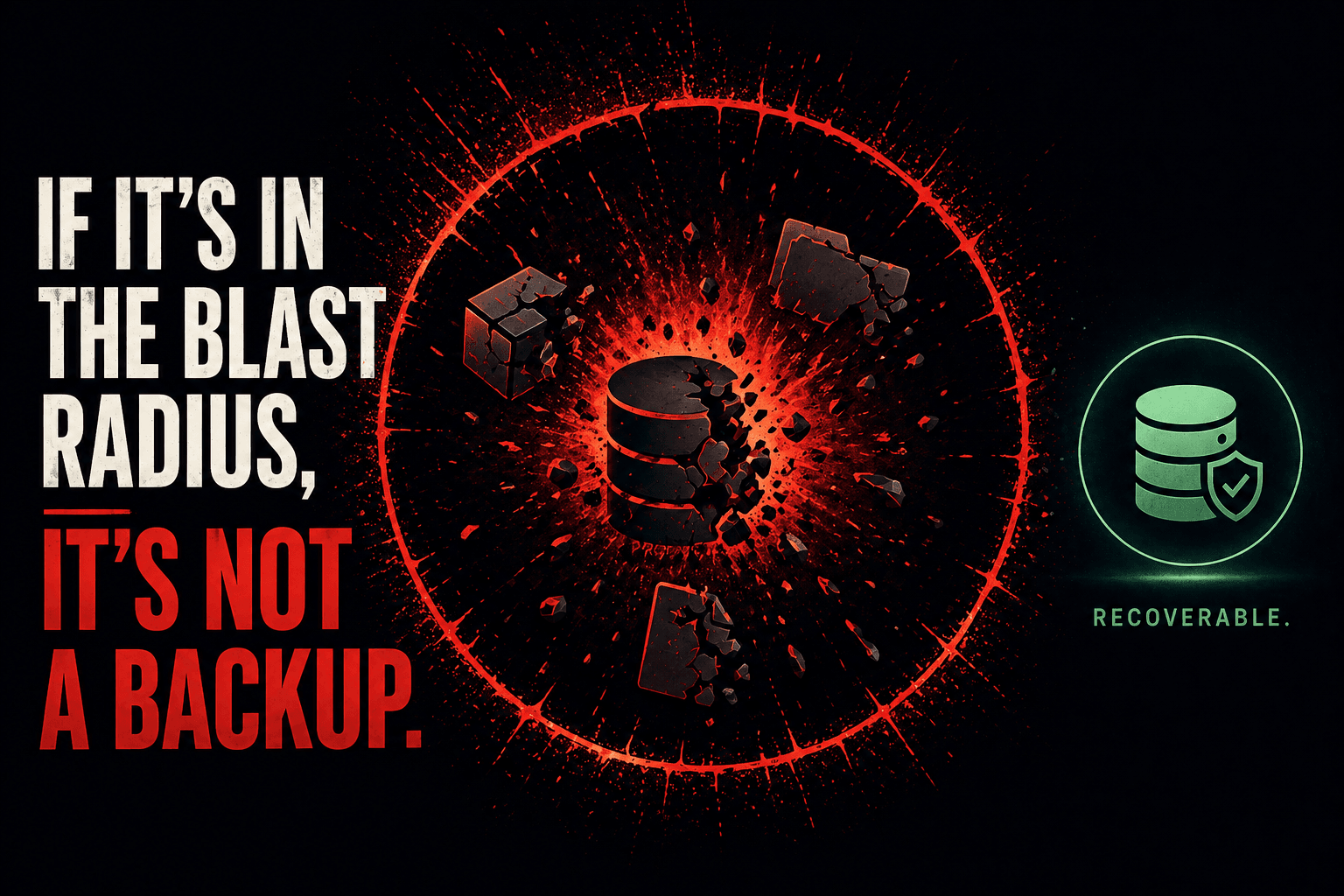
Your Backup Is in the Blast Radius
A SaaS founder lost his production database this week to a 9-second API call.
The recoverable backup was three months old.
The "real-time" backups he thought he had were stored in the same volume that got deleted.
They went together.
If you're running NetSuite, this is a worse story than it looks.
The pattern
A blast radius is the set of things destroyed by a single failure event.
A real backup lives outside it.
If your “backup” can be destroyed by the same event that destroys production — same account, same credentials, same vendor — it isn’t a backup.
It’s a copy.
If you’re reading this and thinking “we’d probably be fine,” you haven’t tested it.
That’s the problem.
What NetSuite customers call backup that isn’t
Sandbox refreshes.
A sandbox is a point-in-time copy inside the same NetSuite account structure, governed by the same vendor and administrative control.
It may survive certain production issues. It may not.
More importantly — it is not designed, maintained, or guaranteed as a recovery system.
Even in the best case, you’re rebuilding production manually from a stale copy.
That’s downtime measured in days or weeks.
Scheduled saved searches.
A CSV in your inbox is not restorable data.
You can rebuild a list.
You cannot rebuild a system.
The audit trail.
System notes tell you what changed.
They do not let you reconstruct what was lost.
If the record is gone, the context is gone.
File Cabinet exports.
If you lose NetSuite, you lose the File Cabinet.
Same blast radius.
“We have it in another system.”
You might have fragments:
- customers in Shopify
- GL somewhere else
But you do NOT have:
- workflows
- script logic
- saved searches
- approvals
- custom fields
- integration state
That only exists in NetSuite.
You can rebuild data.
You cannot rebuild how your business actually runs.
What’s actually outside the blast radius
A real backup requires:
Different credentials.
If the same login can destroy both, it’s not a backup.
Different infrastructure.
Same vendor = shared failure modes.
Tested restoration.
If you’ve never restored it, it’s not a backup.
It’s a theory.
This is not a data lake
A lot of companies hear “data outside NetSuite” and assume they’re covered because they have a warehouse or lake.
They’re not.
A data lake is built for:
- analytics
- reporting
- aggregation
Not recovery.
Most data lakes:
- flatten relationships
- drop system metadata
- lose workflow state
- break referential integrity
- cannot be reloaded into a working system
They answer: “What happened?”
They do not answer: “Can we recover?”
A backup preserves:
- structure
- relationships
- state
If your plan is: “We’ll rebuild from the warehouse”
You won’t.
Not in any timeframe your business can survive.
The part nobody likes
Most NetSuite environments have zero recoverable backup outside the account.
Not bad backups.
None.
What this actually means
If NetSuite goes away:
- You can’t invoice
- You can’t close
- You can’t operate
That’s not a data problem.
That’s a revenue stoppage.
Takeaway
Don’t “plan to look at this.”
Either:
- You have your data outside NetSuite
- Or you don’t
That’s a yes/no question.
If the answer is no:
You don’t have a backup.
You have a vendor relationship and a hope.
Written by Adaptive Solutions Group — we build NetSuite data extraction systems for companies that want their data outside the blast radius.
Dealing with this in your own NetSuite account?
We fix exactly these problems in production. Run a free read-only health scan, or talk to a senior NetSuite consultant who has seen it before.

Written by Mike Pagani, founder of Adaptive Solutions Group — a NetSuite consultancy based in Pittsburgh, PA. Mike has been building SuiteScript automations, integrations, and NetSuite rescue projects since 2013.