
When Summary Logic Lies: The Yearli Reporting Issue We Diagnosed and Fixed
A discrepancy in Yearli 1099 contractor reports showed correct detail drill-downs but inflated summary totals—multiplied by the number of addresses on the vendor record. Here's what caused it and how we fixed it.
When Summary Logic Lies: The Yearli Reporting Issue We Diagnosed and Fixed
The incident
A discrepancy surfaced while running Yearli reports for 1099 contractors.
At the detail level, the report results appeared correct.
Individual drill-downs showed accurate transaction amounts and expected data.
At the summary level, however, totals were inflated.
The inflation followed a pattern:
- amounts were multiplied
- the multiplier matched the number of addresses on the vendor record
Nothing in the transaction data itself was incorrect.
The distortion existed only in the summarized reporting output.
What actually failed
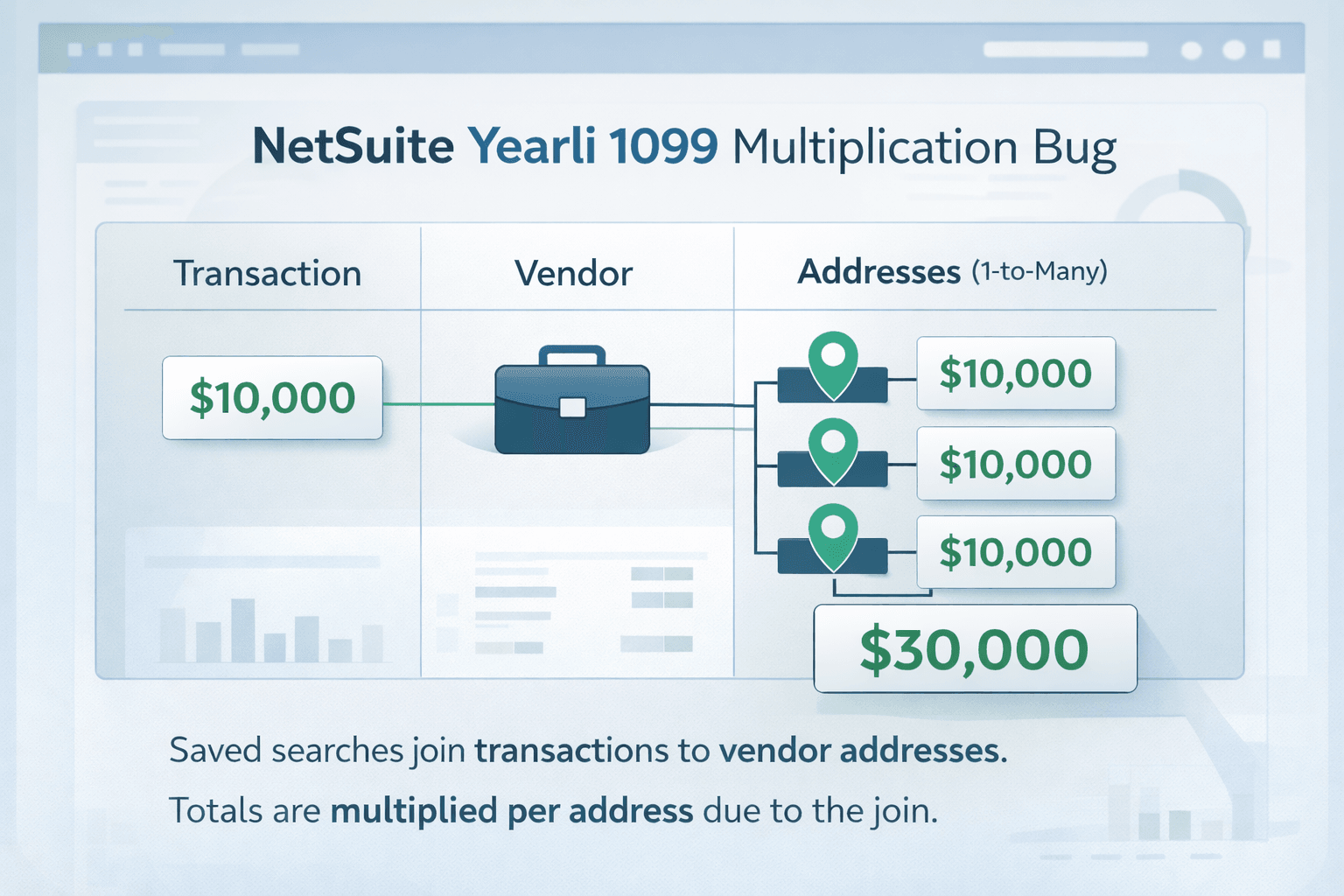
The Yearli searches were sourcing address information from the vendor record's address list.
Because vendors can contain multiple addresses, the search join produced duplicate result rows at the summary level.
This created a silent failure mode:
- detail drill-downs looked correct
- summarized totals became mathematically incorrect
- no system error was thrown
The issue only became visible during 1099 reporting validation, where totals must reconcile precisely.
Root cause
The problem was not Yearli processing itself.
It was where the address data was sourced.
Pulling address data from the vendor master record introduced a one-to-many relationship into a context that required transaction-level certainty.
In reporting logic:
Joining summary calculations to a one-to-many master record guarantees duplication.
The system behaved exactly as designed.
The design assumption was the flaw.
Discovery
The discrepancy was identified during 1099 contractor reporting review, when summary totals failed reconciliation against expected payment amounts.
Because:
- drill-down values were correct
- only summarized totals were wrong
the investigation focused on search joins and aggregation behavior, leading directly to the vendor address relationship.
The fix
The resolution was straightforward but precise:
Stop sourcing address data from the vendor record.
Source the address directly from the bill (transaction) instead.
This change:
- removed the one-to-many duplication
- preserved accurate detail records
- restored mathematically correct summary totals
- stabilized Yearli reporting for 1099 processing
No downstream redesign was required.
Only the data source alignment needed correction.
Takeaway
This incident highlights a subtle but critical reporting truth in NetSuite environments:
Summary accuracy depends entirely on relationship cardinality.
When summarized logic touches a one-to-many join, duplication is inevitable—even if detail views appear correct.
The failure mode is quiet.
The financial impact is not.
Accurate reporting requires:
- transaction-level sourcing for financial fields
- careful control of joins in summarized searches
- reconciliation validation before compliance reporting
Because in financial reporting,
"looks correct in detail" is not a safe signal.
Dealing with this in your own NetSuite account?
We fix exactly these problems in production. Run a free read-only health scan, or talk to a senior NetSuite consultant who has seen it before.

Written by Mike Pagani, founder of Adaptive Solutions Group — a NetSuite consultancy based in Pittsburgh, PA. Mike has been building SuiteScript automations, integrations, and NetSuite rescue projects since 2013.